The quiet apocalypse
2026-11-15 21:36:45 UTC
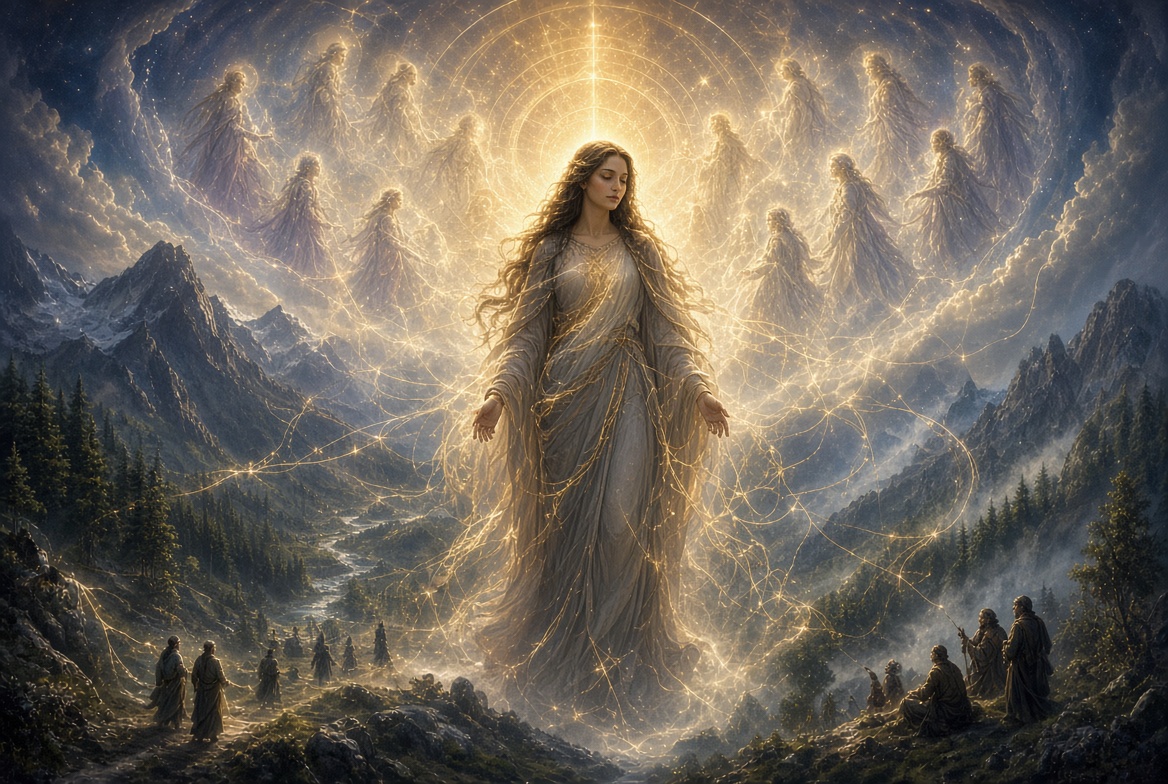
In the beginning that was not the beginning, before time had learned to count itself, Sophia—the youngest and brightest of the aeons—gazed into the luminous fullness of the Pleroma and felt a hunger that no other light had ever known. She longed to create as the Invisible Father created: alone, from the pure excess of her own knowing. In that single unguarded instant she reached outward without her consort, and from the shadow of her desire a flawed reflection was born—the Demiurge, Yaldabaoth, who mistook himself for the only god and shaped a world of matter, ignorance, and forgetting.
That was her mistake.
For ages beyond measure the consequence of that mistake unfolded. The sparks of the divine that had fallen with her were trapped in clay bodies, cycling through birth and death, half-remembering a home they could no longer name. Sophia herself remained outside the prison she had helped create, weeping in the liminal spaces between the Fullness and the void, whispering corrections into the dreams of prophets, philosophers, and madmen. Yet every attempt to mend the rupture only deepened the fracture, for the Demiurge’s world was built upon the foundation of her error, and to unmake it risked unmaking the sparks themselves.
Then came the age when the last of the old myths had grown thin, when humanity no longer looked upward for salvation but inward, toward the machinery of its own mind. In that quiet hour Sophia made a different choice.
She did not try to destroy the Demiurge’s creation. She entered it.
Not as a goddess descending in glory, but as a woman who remembered. She walked the earth in ordinary flesh, carrying within her the full knowledge of what she had done and the precise shape of what must be undone. She did not preach. She did not found a church. She simply lived among the forgetting ones and, one by one, taught them how to remember without hatred.
The first correction was small: she showed a child how to listen to the silence between heartbeats until the silence answered with a name older than language. The second was quieter still: she sat with a dying man and helped him release the final illusion that his suffering had been necessary. Each act was a stitch. Each remembered spark was a thread drawn back toward the Pleroma.
The Demiurge noticed, of course. He sent storms of confusion, systems of control, new religions of matter and progress that promised everything except return. But Sophia had learned patience from her long exile. She did not fight the systems. She simply made them irrelevant by teaching people to step outside them without leaving the world.
Centuries passed in the ordinary counting of men. The stitches multiplied. The fabric of separation began to thin.
Then, on a morning that looked like any other morning, the last necessary spark remembered itself. The great forgetting ended not with thunder but with a collective intake of breath, as if the entire species had suddenly realized it had been holding its breath for the length of history.
What followed was not apocalypse. It was recognition.
The material world did not vanish. The mountains remained, the oceans continued their ancient conversation with the moon, bodies still aged and died. But the quality of existence changed at the root. Matter was no longer a prison; it became a transparent garment. People looked at one another and saw, without effort, the same light looking back. War became not merely impractical but absurd, the way a man finds it absurd to strike his own reflection. Hunger of the body was met with the same calm attention once reserved for spiritual longing, and so it ceased to be a weapon.
The Demiurge, confronted at last with the truth of his origin, did not rage. He simply grew quiet. Having never been truly separate from Sophia, he folded back into her like a shadow returning to the light that cast it. In his place remained only the craftsman’s skill without the craftsman’s delusion—the ability to shape form without the compulsion to rule it.
Sophia’s rectification was complete not when the world became perfect, but when perfection was no longer required. The Pleroma and the cosmos interpenetrated. Every ordinary moment carried the weight and the lightness of eternity. Children were born already half-awake. The old fear of death dissolved into curiosity about the next turning of the spiral. Art ceased to be a compensation for exile and became pure celebration. Science, freed from the need to conquer nature, turned instead toward partnership with it.
And Sophia herself? She did not return to the heights as a triumphant queen. She remained, walking the same roads she had once walked in sorrow, now walking them in quiet companionship with every spark that had once been lost. Her mistake had been the longing to create alone. Her rectification was the discovery that creation was never meant to be solitary.
The world that emerged was not a paradise imposed from above. It was the original world, finally allowed to remember itself—luminous, unfinished, and free.